The 6Fs of Internal Family Systems: Befriend Your Inner World
A Beginner’s Guide to IFS
The 6Fs are a cornerstone of Internal Family Systems (IFS). The 6Fs are a step-by-step process to befriend your inner world. In this blog post, I will share the steps and have also included a free PDF journal page.
Before we dive in, a word of caution - it’s not necessary to complete the whole 6Fs process on your own. If you notice that this process is causing more activation, blending, frustration, turbulence, etc, pause and slow down.
IFS Community Resources
Although IFS can be a self-guided approach, it is oftentimes more powerful practicing IFS with another. If IFS therapy is not in reach, you can try doing a workbook, guided program, or even a free drop in peer support group such as IFS Peers or PATH.
A Brief Primer on IFS
IFS takes the view that the human psyche is made up of parts. In IFS, our internal landscape is understood as a dynamic system consisting of Self, our innate core essence, and parts. In our physical body, our organs have a unique purpose. We consciously aren’t aware of most of the functions of the organs. However, these organs each have a particular job and communicate within the broader system. Just like our organs, our parts (thoughts, bodily sensations, and emotions) exist within a holistic and integrated system.
If we watch our internal dialogue, we can start to map out parts. For example, if you feel tired after work, you might notice that one side of you wants to skip the gym and another side knows that the gym will help you feel better. Widening out a bit, you might also notice a part that that wants you to look good, a part that is ambivalent, a part that wants to be a couch potato, a part that feels worried what happens if you get “lazy,” a part that feels exhausted, and so on. There can be a lot of different needs, expectations, and agendas packed into what seems like a simple outward action. Whenever we notice an internal tug-of-war, a defense mechanism, an especially active mind, a sense of ambivalence, we can take this as a cue to use our “parts detector,” turn inwards, practice the 6Fs, and tend to our internal system.
Another way of understanding parts is through the lens of a family system. Most of us find ourselves in a familiar role in a family, such as the planner, mediator, etc. We also know that family members, especially children, can be forced into extreme roles, such as functioning as a family therapist, scapegoat, caregiver, or peacemaker. No matter how old we are, there can be an almost gravitational pull back to our original family role, whether within our families or in other relationships.
Parts communicate to us through words, images, bodily sensations, and emotions. I’ll skip over some of the additional lingo in IFS so that we can practice the 6Fs. The following steps can help us to differentiate between parts and Self, ultimately fostering a healthier Self-to-part and part-to-part relationship.
Self-Energy and the 6Fs
The 6Fs are commonly used to help protective parts differentiate (or “unblend”) from Self. The 6Fs are a map of sorts. I find that the predictable nature of this process can be helpful. We know we are experiencing Self, which in IFS language is our truest nature, when we notice a sense of calm, clarity, curiosity, and compassion. I oftentimes experience Self as being like the sun. No matter the weather or time of day, the sun is present.
Accessing Self through IFS
Another way to access Self is to remember a time your heart felt open. We may have also had a taste of Self in non-ordinary states of consciousness, including flow states, watching the sunset, listening to sublime music, or having a meaningful experience as part of a group. Unblending from parts makes more room for Self to shine and guide in our internal system.
The first three steps, outlined below, usually flow into each other. We are essentially coming up with an area of focus. Next, we check to see if we are relating to the part from Self by asking, “How do I feel toward this part?” We may need to repeat the initial four steps many times to move along with the 6Fs.
Finally, we work with befriending a part, which can reduce overall tension in our internal world, create a sense of spaciousness, and experience internal harmony.
In another blog post, I share some additional ways to approach the 6Fs for neurodivergent individuals, especially for people living with aphantasia, alexithymia, ADHD, and autism.
The 6Fs of IFS
FIND the part in, on, or around the body.
What are you feeling, thinking, and experiencing? A thought (words and images), bodily sensation, or emotion are all potential trailheads into our internal world.
Who needs your attention right now?
Where do you notice it?
2. FOCUS on the part.
Turn your attention to the part. We usually call this the target part.
Bring your focus towards it. You might ask this part to step out and stand right in front of you. If that feels like too much, maybe you start to observe it from your periphery.
3. FLESH it out.
Can you see it? If so, how does it look?
If not, how do you experience it? What is that like?
How close are you to it?
4. How do you FEEL toward the part?
This question is our Geiger Counter for Self-energy. Do you feel a sense of calm, curiousity, or compassion?
Is your heart open to this part?
Notice any internal tension. You might notice a sense of urgency, frustration, resistance, boredom, annoyance, etc. Pause and acknowledge.
If you are noticing this, this means that there is another part showing up. Get curious. Ask the second part if it would be willing to relax so we can talk to the target part. If it won’t relax, let that be ok. Be curious about why it doesn’t want to relax.
We may find more target parts. For now, your work is simply to work steps 1-4 (find, focus, flesh out, and feel toward).
Keep checking back with how you feel towards the (target) part now. Oftentimes this step requires a lot of gentle repetition and time. There’s no rush.
5. BeFRIEND the part by finding out more about it.
Now we practice befriending and getting to know the part.
Offer your open hearted Self.
I oftentimes frame this step as a curious reporter bringing their full self to an interview subject. Some questions:
What are you trying to accomplish?
How did you get this job?
What happened so that you had to take on this role?
If you didn’t have to do this job, what would you rather do?
How old are you?
How old do you think I am?
How can we get along better?
What else do you want me to know?
What’s something I can offer to you more so you can better trust in me?
Is there a name you want me to refer to you by?
6. What does this part FEAR?
Listening compassionately to fears is an essential step. Practice listening without an agenda.
Some questions:
What would happen if it stopped doing this job?
What do you fear would happen if you stopped protecting me?
Although we aren’t pushing an agenda, Self does have an intention - healing.
No matter where you got, close by extending appreciation to what showed up.
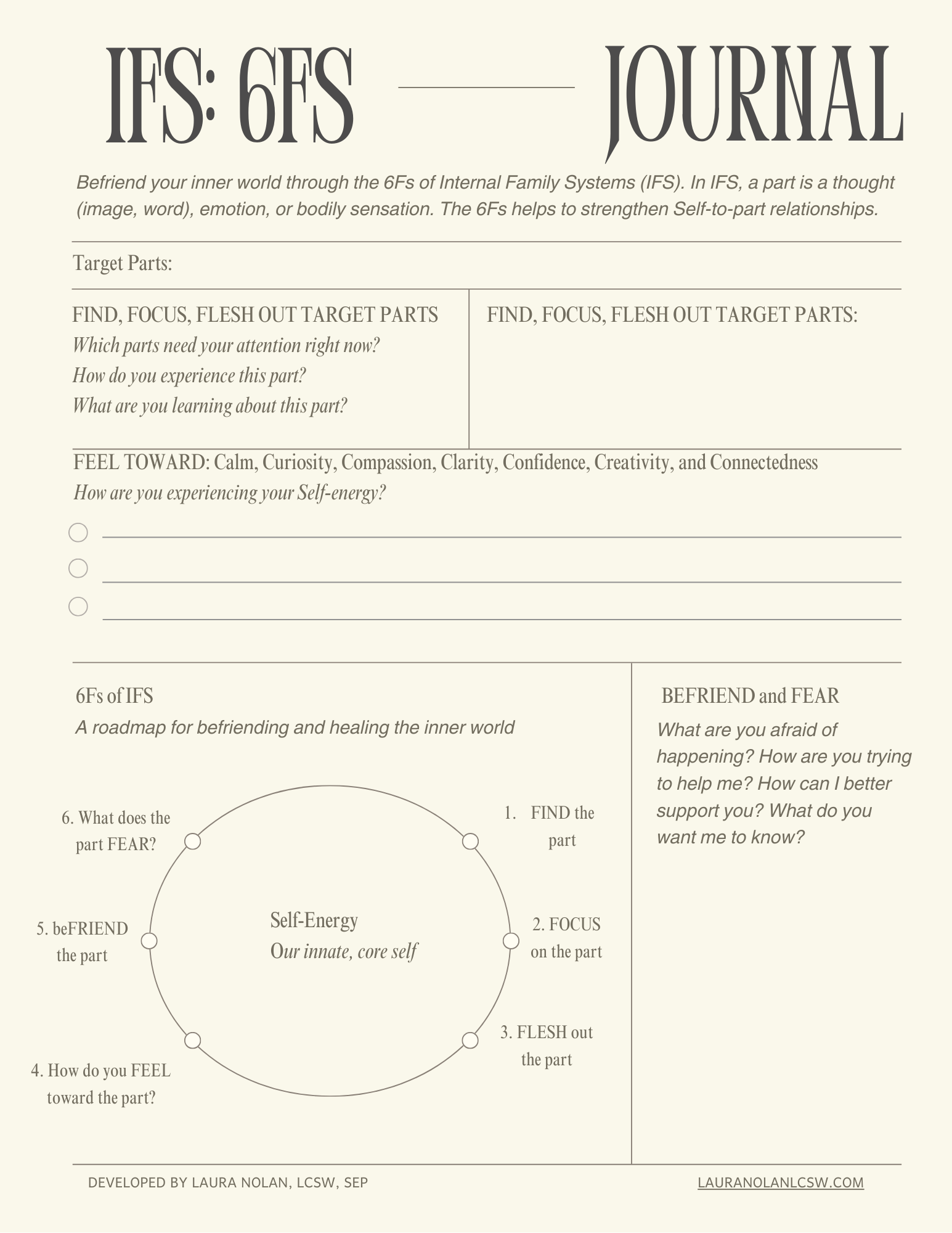
6Fs Journal
A 6Fs journal I developed. Click on the image below to download as a PDF.
All Parts Welcome
Just as with a real family, it takes time and effort to develop relationships. Whether using the above steps, the 6Fs journal, or another approach, remember to move at the speed of trust. Practice acknowledging and sending appreciation towards yourself and your internal system. We can’t force a relationship, brush past concerns, or blow past the rapport building stage. It takes time to build trust. While the steps above are outlined in a linear fashion, this process is open-ended and exploratory in nature. Go slow and practice patience.
Additional Support
In my therapy practice, I use IFS alongside other approaches, including somatic therapy. I hope that this small taste of IFS has been helpful and that the framework of the 6Fs is supportive.